Formula 1 - A Beginner's Guide
What is Formula 1?
The Formula in Formula 1 (F1) refers this to the set of rules and regulations to be adhered by all the teams in the sport. This set of rules is decided by Fédération Internationale de l’Automobile (FIA), a french organization. The sport began its life in 1950. A season in F1 is spread over a year and usually begins with testing at the end of February and ends with a final race sometime in late November or early December. There is a summer break around the month of August. A detailed schedule of the events is announced by the FIA in the preceding year.
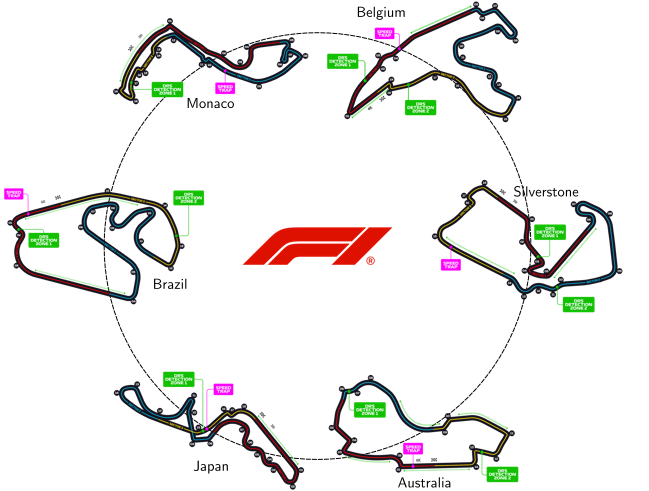
More recently, a season in F1 hosts around 22-24 races at different locations around the globe. Each race is held on a weekend (fans refer to a week as a race week if there is a race at the end of it) and is an elaborate event. Some of the staple locations include Australia (Melbourne Grand Prix Circuit), Japan (Suzuka Circuit), Bahrain (Bahrain International Circuit), Imola (Autodromo Enzo e Dino Ferrari), Monaco (Circuit de Monaco), Spain (Circuit de Barcelona-Catalunya), Great Britain (Silverstone Circuit), Belgium (Spa-Francorchamps), Italy (Autodromo Nazionale Monza), and Abu Dhabi (Yas Marina Circuit).
Who are the players?
Currently, there are 10 teams participating in the sport. Each team usually employs three or more drivers. However, only two of those are the main contestants, with the rest being reserve drivers used for stand-ins or car/simulation development purposes. Thus, every weekend, there are two cars per team on the track. Here’s a list of the teams and their drivers at the time of writing this guide:
| Sr.No. | Constructor/Team | Drivers |
|---|---|---|
| 1 | Red Bull Racing | Max Verstappen, Yuki Tsunoda |
| 2 | Mercedes | George Russell, Kimi Antonelli |
| 3 | Ferrari | Charles Leclerc, Lewis Hamilton |
| 4 | McLaren | Lando Norris, Oscar Piastri |
| 5 | Aston Martin | Fernando Alonso, Lance Stroll |
| 6 | Alpine | Pierre Gasly, Franco Colapinto |
| 7 | Williams | Alex Albon, Carlos Sainz |
| 8 | RB (Visa Cash App) | Isack Hadjar, Liam Lawson |
| 9 | Kick Sauber | Nico Hulkenberg, Gabriel Bortoleto |
| 10 | Haas | Esteban Ocon, Oliver Bearman |
Most people recognize Ferrari, as they should, since it is one of the oldest team alongside other older teams like Mclaren, Williams and Sauber. The period from 2010-2023 has been dominated by Red Bull Racing and Mercedes in terms of overall performance.
How’s a race weekend structure?
Traditionally, a race event would be spread across three days. The usual race event begins on a Friday and ends on the subsequent Sunday (race day). Certain exceptions are made for races in the Gulf countries for religious reasons and the races are held on a Saturday. The structure of a regular race week is as follows:
| Day | Event |
|---|---|
| Friday | Free Practice 1 and 2 |
| Saturday | Free Practice 3, Qualifying |
| Sunday | Race |
Free Practice
A Free Practice (FP) session, FP1/2/3, is a one-hour session. These are meant to be used by the teams to set-up the cars, test new parts and check all other technical details. Teams usually perform different simulations to get an idea of the car’s performance under qualifying and race conditions.
Qualifying
The purpose of this session is to determine the starting position of the drivers on the race day. It consists of three parts Q1, Q2, and Q3. In each session, the participating teams and drivers must go out on the track and set a lap-time. At the end of Q1, which is of 18 mins, the slowest 5 drivers are eliminated (and their positions determined). Similarly at the end of Q2 (15 mins), 5 more drivers’ positions are fixed and are eliminated from qualifying. The last stage i.e., Q3 is of 12 minutes and the positions of the top 10 remaining drivers is decided. The driver starting in the first is said to be on pole or in pole position.
Race
This the main event were the points are awarded in a regular race weekend. Depending on the circuit, the race distance is ~300 Km, the race time is ~1.5-2 hours, and number of laps range from 50s-70s. At the end of a race the points are awarded as per the finishing position:
| Finishing Position | Number of Points Awarded | Finishing Position | Number of Points Awarded |
|---|---|---|---|
| 1st | 25 | 6th | 8 |
| 2nd | 18 | 7th | 6 |
| 3rd | 15 | 8th | 4 |
| 4th | 12 | 9th | 2 |
| 5th | 10 | 10th | 1 |
What’s at stake?
At the end of each season, the FIA awards the coveted World Drivers Championship (WDC) and World Constructors Championship (WCC). Each weekend, the drivers get points based on their performance. These points are tallied at the end of the year and the driver with most points gets the WDC and the team (points of a team = points of driver 1 + points of driver 2) with the most points get the WCC.
Apart from recognition, the teams get prize money from the FIA. In addition, a team that is higher up in the standings is more likely to attract sponsorship opportunities. Thus, often you will find competitive racing for even lower positions during a race.
Here is a list of the WDCs from the 2000s:
| Year | WDC | Year | WCC |
|---|---|---|---|
| 2000-04 | Michael Schumacher (Ferrari) | 2000-04 | Ferrari |
| 2005-06 | Fernando Alonso (Renault, now Alpine) | 2005-06 | Renault |
| 2007 | Kimi Raikonnen (Ferrari) | 2007-08 | Ferrari |
| 2008 | Lewis Hamilton (Mclaren) | 2009 | Brawn GP |
| 2009 | Jenson Button (Brawn GP, now Mercedes) | 2010-13 | Red Bull Racing |
| 2010-13 | Sebastian Vettel (Red Bull Racing) | 2014-21 | Mercedes |
| 2014-15 | Lewis Hamilton (Mercedes) | 2022-23 | Red Bull Racing |
| 2016 | Nico Rosberg (Mercedes) | 2024 | Mclaren |
| 2017-20 | Lewis Hamilton (Mercedes) | ||
| 2021-24 | Max Verstappen (Red Bull Racing) |
From this table, it can be inferred that the WDC will usually be from a team winning WCC. It is, however, not impossible to have a WDC from team other than WCC. Just last year, we had Max Verstappen from Red Bull Racing crowned as the WDC whereas Mclaren were the WCC. This aberration may be attributed to good performance from both the drivers of a team. Many reports suggested that the Red Bull’s car last year was very tricky to drive. Max was able to adapt to this and consistently performed as opposed to his teammate who struggled to adapt to the car’s characteristics.
Acknowledgements: The entire article has been authored by me. The images have been borrowed from different sources online. Some images have been edited by me to create charts/collage. All such images are created using Inkscape. This article is intended for information purposes only.